



Cosmetic Laboratory: Role, Functions, and Limits in Product Development


A cosmetic laboratory formulates and tests products, but it does not usually manage the full development process through to market launch. Its role is mainly upstream, before industrial production begins.
By the end of this article, you will clearly understand what a cosmetic laboratory does, where its role begins and ends, and why it is a key step in cosmetic development, but not a sufficient one on its own.
As demand grows for more targeted and sophisticated beauty products, brands rely on different partners to develop a cosmetic product.
Among them, the cosmetic laboratory plays a central role in formulation and technical development. Yet its scope is still often confused with that of a cosmetic manufacturer or a cosmetic CDMO.
By the end of this article, you will clearly understand what a cosmetic laboratory does, where its role begins and ends, and why it is a key step in cosmetic development, but not a sufficient one on its own.
What is a cosmetic laboratory?
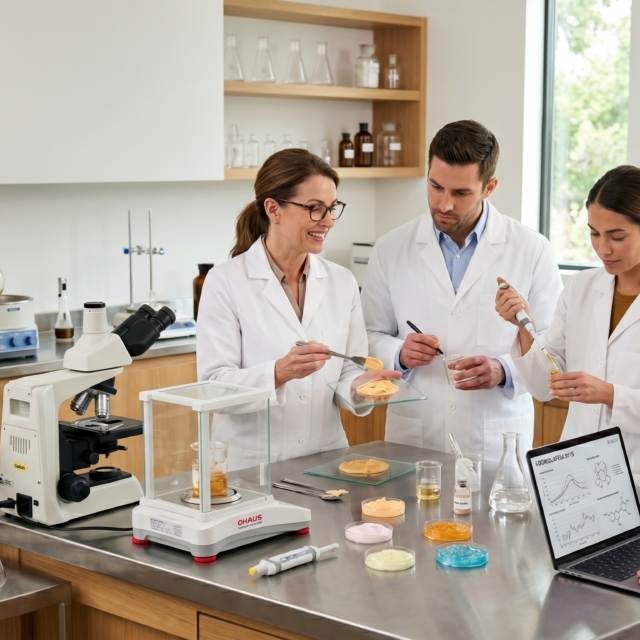
A cosmetic laboratory is a structure specialized in cosmetic formulation, testing, and technical product development.
It mainly operates in the upstream phases of product creation, especially in:
- formula design
- ingredient selection
- galenic development
- stability and compatibility testing
- product safety assessment support
A cosmetic laboratory is therefore an essential part of cosmetic product development. It helps ensure that a formula is technically sound, coherent, and suitable for further development.
In some cases, the laboratory is integrated within a larger company. In others, it works as an external technical partner.
Cosmetic laboratory, manufacturer, and contract partner: what is the difference?
These three roles are often confused, even though they do not cover the same responsibilities.
Cosmetic laboratory
- specialized in formulation and testing
- involved during the development phase
- focused on technical feasibility
Cosmetic manufacturer
- responsible for industrial production
- involved after the formula has been validated
- focused on manufacturing execution
Cosmetic CDMO
- coordinates the broader project
- can integrate formulation, production, regulatory support, and quality
- supports the product through to market readiness
In simple terms: the laboratory formulates, the manufacturer produces, and the cosmetic CDMO (Contract Development and Manufacturing Organization) structures and secures the overall project.
Read more on:
Cosmetic CDMO: definition, role and how to choose the right partner
The 5 key roles of a cosmetic laboratory
1. Developing the product formula
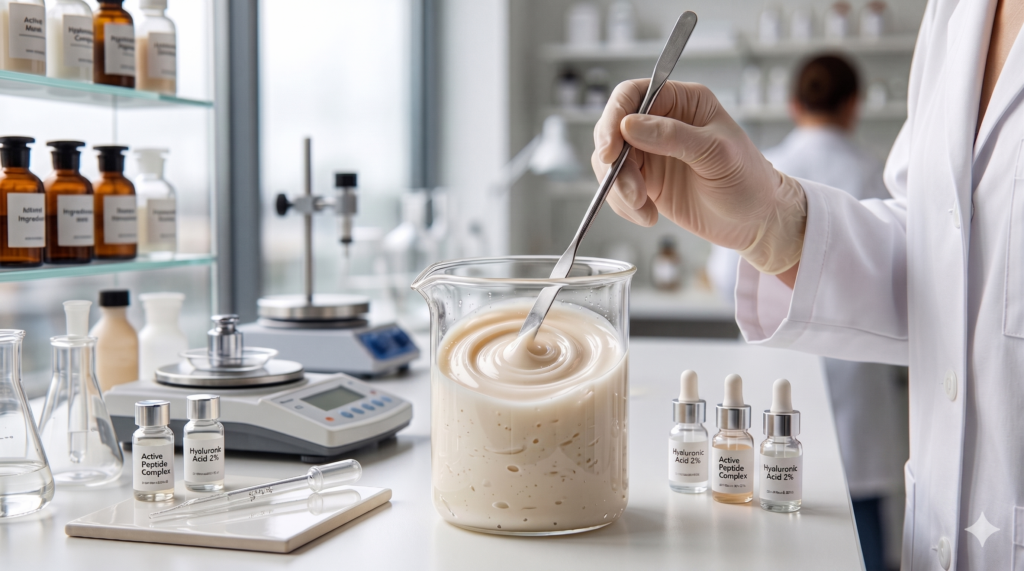
Formulation is at the core of a cosmetic laboratory’s work.
This includes defining:
- active ingredients
- excipients
- texture
- formula stability
Each parameter is adjusted to meet a specific objective, whether that is performance, stability, tolerance, texture or sensorial profile.
Read more on: How to Structure Skincare Product Development for a Custom Range
2. Running stability and compatibility tests
A cosmetic laboratory checks whether the formula:
- remains stable over time
- withstands temperature variation
- is compatible with the selected packaging
These tests are essential before any industrial scale-up.
3. Developing the galenic form
Cosmetic galenics determine the product’s physical form and user experience.
This may include:
- cream
- serum
- lotion
- balm
- stick
The galenic form influences texture, application, sensoriality, and perceived performance.
4. Validating technical feasibility
The laboratory also evaluates whether a formula can realistically be reproduced on a larger scale.
This means anticipating:
- industrial constraints
- ingredient interactions
- instability risks
- scale-up challenges
5. Supporting the early stages of the project
A cosmetic laboratory may also support upstream decision-making, including:
- selection of active ingredients
- formulation direction
- fit with product objectives and market expectations
Its role is technical, but it often helps shape the project at a critical stage.
The limits of a cosmetic laboratory in a cosmetic project
A cosmetic laboratory does not usually cover the full product development cycle.
In most cases, it does not handle:
- industrial manufacturing
- filling and packaging operations
- market launch coordination
- full project management
It is therefore a specialized technical player, not necessarily an end-to-end development partner.
On its own, a cosmetic laboratory is not enough to bring a product to market without additional partners.
Why choosing the right model is strategic
Choosing between a laboratory, a manufacturer, and a cosmetic CDMO has direct consequences on:
- time-to-market
- project complexity
- regulatory consistency
- product continuity
When several separate partners are involved, such as a cosmetic laboratory, a manufacturer, and regulatory experts, project management can quickly become more complex.
By contrast, a more integrated model can help:
- centralize expertise
- reduce operational risk
- streamline development
ALPOL Cosmetique’s approach
ALPOL Cosmetique does not position itself solely as a standalone cosmetic laboratory.
Its model is based on an integrated organization combining:
- in-house R&D laboratory
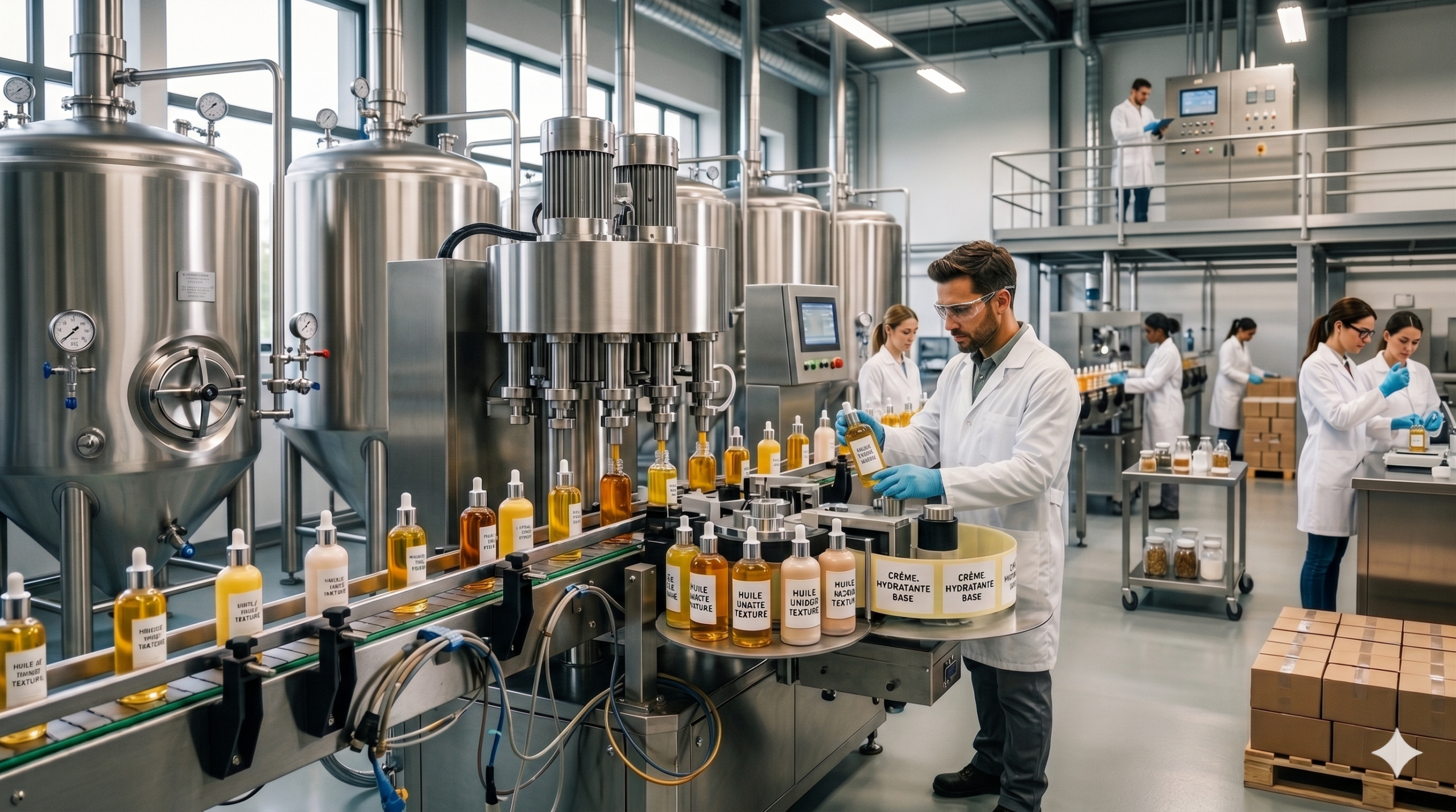
- industrial production capabilities with advanced equipment
- a structured regulatory affairs department
- a dedicated quality department
This setup ensures continuity between formulation, industrialization, and market readiness.
It also helps secure product compliance, reproducibility, and overall development reliability.
Cosmetic laboratory in 5 key takeaways
- A cosmetic laboratory mainly handles formulation and testing
- Its role is technical and upstream in the project
- It does not usually cover the full product lifecycle
- Additional partners are often needed for industrialization and launch
- It is frequently integrated into a broader cosmetic CDMO model
Frequently asked questions about cosmetic laboratories
Do you have a cosmetic product project?
A cosmetic laboratory is a key step in formulation, but it is not enough to structure a cosmetic project from start to finish.
ALPOL Cosmetique supports brands across the full product lifecycle, from concept to market readiness, by integrating the expertise needed to secure each stage of development.
You might also be interested in
At the heart of responsible cosmetic innovation
For professionals seeking more information about how we work, our products or our support: visit our website or follow us on LinkedIn.