


Cosmetic Manufacturer in France: Mastering the Industrial Production of Cosmetic Products


A cosmetic manufacturer is a company specialising in the industrial production of cosmetic products. It is responsible for manufacturing, filling, packaging, and ensuring consistent product quality at scale, while operating within a controlled and fully compliant production environment.
Cosmetic Manufacturer in France: Mastering the Industrial Production of Cosmetic Products
Choosing a cosmetic manufacturer is no longer just about production capacity.
Today, brands are looking for manufacturing partners that can deliver consistent quality, product stability, batch-to-batch reproducibility, and scalable production, while ensuring full compliance with industry regulations and technical standards.
By the end of this article, you’ll have a clear understanding of the role of a cosmetic manufacturer in France and the industrial capabilities that brands now expect from their manufacturing partners.
What is a Cosmetic Manufacturer?
A cosmetic manufacturer is a company specialising in the industrial manufacturing of cosmetic products.
Its core responsibilities include:
- manufacturing cosmetic products,
- filling and packaging finished products,
- ensuring batch-to-batch consistency and reproducibility,
- maintaining rigorous quality standards,
- ensuring compliance with manufacturing regulations and industry requirements.
Unlike a cosmetic laboratory, which focuses primarily on product formulation, a cosmetic manufacturer is responsible for the industrial and operational aspects of production. This includes managing manufacturing processes, scaling up production efficiently, and ensuring consistent product quality across high-volume manufacturing runs.
Why industrial manufacturing capabilities have become a key differentiator in the cosmetics industry?
The cosmetics industry is evolving towards increasingly sophisticated, high-performance products that are often more complex to manufacture.
Air-whipped textures, hot-pour formulations, sticks, balms and hybrid galenic forms now require advanced industrial equipment and properly adapted manufacturing processes.
As a result, brands are looking for cosmetic manufacturers capable of ensuring:
- stable production processes,
- consistent formulation quality across batches,
- precise temperature control,
- accurate dosing,
- reliable industrial reproducibility.
Industrial capabilities have therefore become a strategic criterion when selecting a French cosmetic manufacturer.
To go further: How to structure skincare product development for a custome range
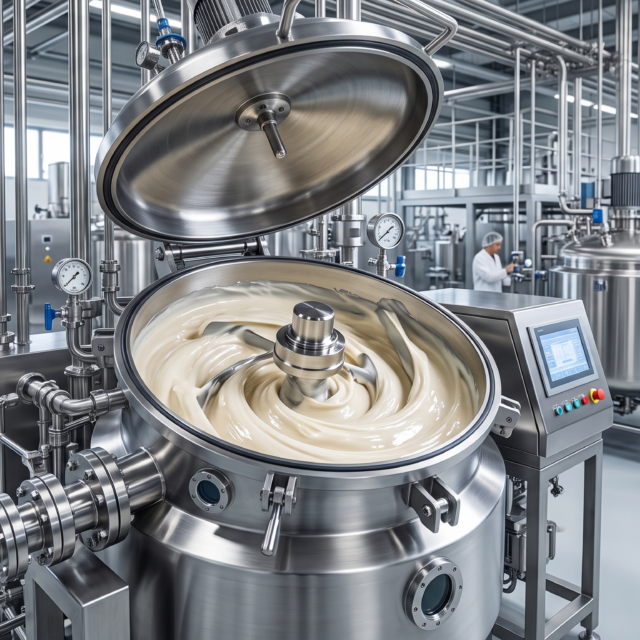
CDMO in France: what industrial capabilities should you expect?
A French cosmetic manufacturer, or cosmetic CDMO (Contract Development and Manufacturing Organisation), must now address several key industrial challenges:
1. Ensuring formulation reproducibility
A formula validated at laboratory scale must be reproducible at industrial scale without affecting:
- its stability,
- its texture,
- its sensorial profile,
- its performance.
2. Mastering technical manufacturing constraints
Certain cosmetic galenic forms require:
- high-temperature processing,
- dedicated cooling systems,
- precise dosing equipment,
- homogeneous mixing capabilities.
These constraints are particularly critical in hot-pour products.
3. Ensuring compliance and quality standards
Cosmetic manufacturing in France requires compliance with:
- Good Manufacturing Practices (GMP),
- the European Cosmetic Regulation,
- strict quality, safety and traceability requirements.
A cosmetic manufacturer must ensure production stability, full batch traceability, and regulatory compliance at industrial scale.
4. Supporting evolving market trends
Current trends in the cosmetics industry are driving demand for:
- travel-friendly formats,
- cosmetic sticks,
- solid textures,
- hybrid galenic formulations.
These developments require specific industrial capabilities and adapted manufacturing equipment, particularly for controlled cooling systems and precise temperature management.
Discover: How private label for cosmetics accelerates range development
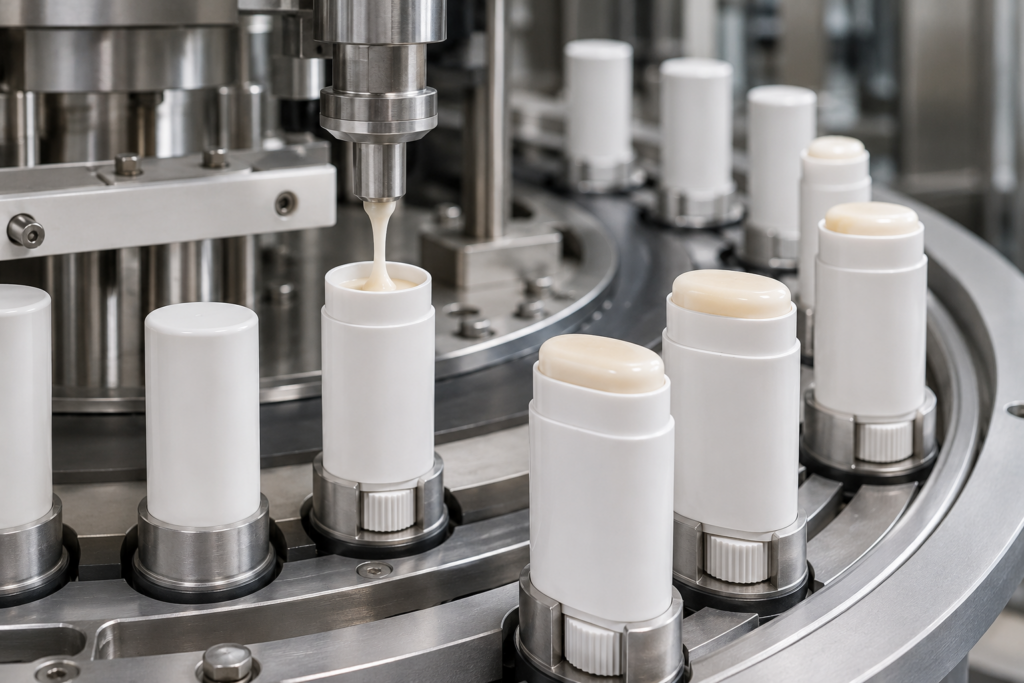
Hot-pour products, cosmetic sticks and technical formulations: today’s manufacturing challenges
The development of hot-pour products, such as sun sticks, illustrates the increasing industrial complexity in cosmetic manufacturing.
These products require, in particular:
- precise temperature control,
- perfect homogeneity of mixtures,
- suitable cooling systems,
- accurate filling precision,
- formula/packaging stability.
Hot-pour products therefore represent a significant technical challenge for cosmetic manufacturers. They require a high level of industrial control to prevent texture defects, filling inconsistencies, and instability issues between the formula and the packaging.
Case study: how ALPOL Cosmétique expanded its industrial manufacturing capacity
To support evolving market needs, ALPOL Cosmétique, a French cosmetic CDMO, has invested in a new production line dedicated to the filling of hot-pour cosmetic products in jars and sticks.
This line notably includes:
- a positive-temperature cooling tunnel,
- a dosing system that keeps ingredients at a controlled temperature,
- a melting unit capable of handling formulations heated to over 100°C.
ALPOL Cosmétique has also integrated a 600L melting unit to increase its production capacity for hot-pour formulations.
These investments now enable ALPOL Cosmétique to:
- increase its industrial manufacturing capacity,
- improve production flexibility,
- meet the requirements of complex and technical formulations,
- ensure the industrial reproducibility of cosmetic products.
The integration of this new equipment has also required upskilling teams on new industrial processes and on the specific constraints associated with hot-pour textures.
To go further: Cosmetic CDMO: The Key to Custom Development in the Beauty Industry
The ALPOL Cosmétique approach
At ALPOL Cosmétique, cosmetic manufacturing is part of a fully integrated industrial partnership approach.
R&D, production, quality, procurement, regulatory affairs and marketing teams work in close coordination to ensure alignment between product development, industrial constraints and market requirements.
This integrated cosmetic contract manufacturing model enables ALPOL Cosmétique to:
- anticipate production constraints as early as the development stage,
- secure industrial batch-to-batch reproducibility,
- ensure controlled production scale-up,
- respond to complex and technically demanding galenic formulations.
Cosmetic manufacturer: 4 key takeaways
- A cosmetic manufacturer is primarily responsible for the industrial production of cosmetic products
- Industrial manufacturing capabilities have become a strategic criterion in the cosmetics sector
- Technical products require specific industrial capabilities
- Reproducibility and compliance are major industry challenges
FAQ on cosmetic manufacturers in France
Do you have a cosmetic project?
ALPOL Cosmétique supports beauty brands in developing their product ranges, from formulation and product design through to market launch, integrating industrial constraints, quality requirements, regulatory compliance, and batch-to-batch reproducibility.
You might also be interested in
At the heart of responsible cosmetic innovation
For professionals seeking more information about how we work, our products or our support: visit our website or follow us on LinkedIn.