


How Chinaʼs CSAR Shapes Cosmetic Compliance


CSAR China cosmetic regulation has governed cosmetics placed on the Chinese market since 1 January 2021. More structured, more demanding, and still evolving through implementing rules, it requires foreign brands to manage cosmetic compliance in China with much tighter regulatory discipline than before.
By the end of this article, you will understand the key requirements of Chinaʼs new cosmetic regulation CSAR, the main implementation milestones, and the practical implications for cosmetic compliance and market access in China.
What is CSAR China cosmetic regulation?
The Cosmetic Supervision and Administration Regulation (CSAR) is the framework that reshaped cosmetic supervision in China. It was promulgated in 2020 and took effect on 1 January 2021, replacing the previous administrative framework with a broader lifecycle approach.
Its purpose is to strengthen the quality, safety, and supervision of cosmetics sold in China. In practice, CSAR China does not stop at registration or filing. It also covers raw materials, labeling, efficacy test, safety assessment, manufacturing, and post-market responsibilities (source: Cosmetics Obs).
It notably frames:
- product registration and filing
- ingredient management
- efficacy test
- safety assessment
- manufacturing and marketing supervision
- post-market obligations
The official authority in charge is the NMPA (National Medical Products Administration).
CSAR China in 5 key points
- It took effect on 1 January 2021.
- It applies a lifecycle approach to cosmetic supervision.
- It distinguishes between special cosmetics and general cosmetics.
- It strengthens oversight of ingredients and new cosmetic ingredients.
- It formalizes safety assessment requirements, with a key transition threshold on 1 May 2025.
Source: NMPA (National Medical Products Administration), Cosmetic Supervision and Administration Regulation, 2021
The core principles behind Chinaʼs CSAR
CSAR China is built around three major pillars:
1. Clearer product classification
Under Chinaʼs CSAR, cosmetics are handled through registration or filing depending on category, with different requirements for special cosmetics, general cosmetics, and new cosmetic ingredients. Overseas applicants must also designate a domestic responsible person in China.
2. Stronger ingredient control
Chinaʼs new cosmetic regulation CSAR reinforces control over raw materials and ingredient data. The NMPA implementation notice requires ingredient source information, and broader safety-related information for all ingredients with supplementary obligations for existing products.
3. Formalized safety assessment
Safety assessment is now a core compliance pillar. The NMPA issued optimization measures confirming that some qualified general cosmetics may submit the basic conclusions of the safety assessment, while keeping the full report on file.
The simplified report route for certain applications remained available only until 1 May 2025.
Chinaʼs CSAR main implementation milestones (2021–2025)
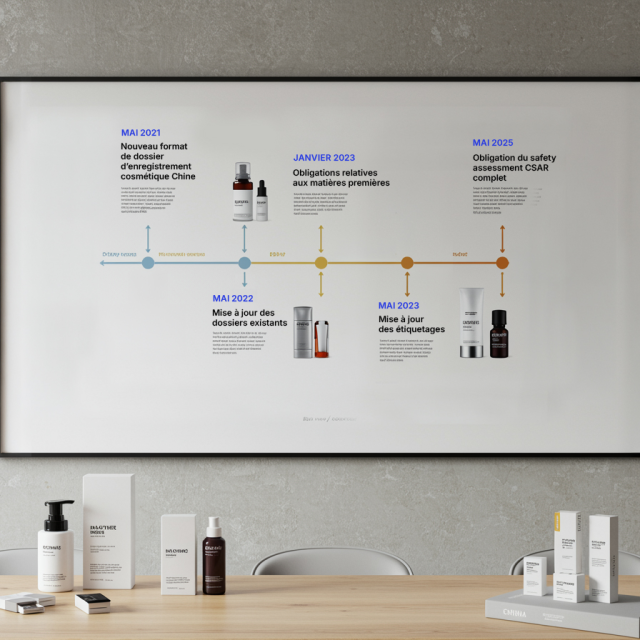
The rollout of CSAR China cosmetic regulation has been phased over time. Key milestones include:
- May 2021: new format for China cosmetic registration and filing dossiers
- May 2022: update of existing dossiers and publication of efficacy summaries
- January 2023: new obligations relating to raw material safety-related information
- May 2023: supplementary dossier updates for existing products under the new framework
- May 2025: end of the transition period for simplified safety assessment reporting under CSAR
This phased implementation has made China cosmetic dossier management more complex, especially for brands already active on the market before the post-CSAR framework was fully operational.
What CSAR China changes for cosmetic companies
CSAR China cosmetic regulation significantly increases the responsibility of companies placing cosmetic products on the Chinese market.
Main changes include:
- more rigorous safety requirements
- stricter efficacy test expectations
- greater transparency on cosmetic products and manufacturing
- centralized management of ingredient-related data
- stronger post-market supervision
CSAR China broadens the responsibility of importers, manufacturers, registrants, and filing entities. Cosmetic compliance in China must be maintained throughout the productʼs lifecycle, not checked only at the time of export or first filing.
In the event of non-compliance, sanctions may include:
- product recall or withdrawal
- suspension of registration or filing activities
- administrative penalties
- broader market consequences depending on the breach and the operatorʼs obligations under the framework
Cosmetic compliance in China: strategic points of vigilance
To secure cosmetic market access in China, several elements are critical:
- early validation of ingredient acceptability under Chinese cosmetic requirements
- consistency between marketing claims and efficacy substantiation
- a properly structured China cosmetic registration or filing dossier
- a documented and compliant safety assessment strategy
- ongoing regulatory watch
Chinaʼs CSAR is an evolving framework. One-time compliance is not enough. Compliance has to be maintained over time.
ALPOL Cosmetiqueʼs regulatory support
In this demanding context, regulatory control becomes a strategic lever.
ALPOL Cosmetique supports brands through:
- an integrated Regulatory Affairs function
- continuous international regulatory monitoring
- expertise in assessing export compliance for China
This support may include:
- formula compliance analysis
- ingredient list verification
- support on CSAR safety assessment requirements
- consistency checks between claims and dossier logic
The objective is to integrate regulatory requirements upstream in product development in order to secure cosmetic market access in China within a controlled and compliant framework.
Key points to remember
- CSAR China regulates the full lifecycle of cosmetic products
- CSAR China entered into force on 1 January 2021
- Safety assessment requirements have been reinforced, with a key transition ending on 1 May 2025
- Efficacy substantiation expectations are stricter
- The responsibility of market operators has been expanded
- Cosmetic compliance in China must be maintained over time
FAQ on Chinaʼs CSAR
Are you developing a product for the Chinese market?
In a regulatory environment as structured as CSAR China cosmetic regulation, anticipation and documentary rigor are critical.
Contact ALPOL Cosmetique to secure your regulatory compliance strategy and structure your China cosmetics export project within a controlled framework.
You might also be interested in


At the heart of responsible cosmetic innovation
For professionals seeking more information about how we work, our products or our support: visit our website or follow us on LinkedIn.